About Feral Flowers
Feral Flowers is a forty-year photographic archive dedicated to California’s wildflower landscapes—places photographed during extraordinary moments of bloom, many of which have since changed through development, land use and a changing climate.
What began in the 1980s with drives into the California desert—a way to detox, heal and find restoration in nature—gradually became a sustained photographic record of wildflower landscapes whose blooms may last at most a month, more often a few weeks and sometimes only a few days before disappearing again.

About the Work
The earliest photographs were made with Canon 35mm film cameras using a range of lenses and filters. Much of the archive was recorded on transparency film, a demanding medium with little tolerance for exposure error and very limited opportunity for correction once the exposure had been made.
Over time, the work developed around atmosphere—the quality of the air, seasonal moisture, wind, cloud movement and the direction of light. These conditions could transform the appearance of flowers and terrain from one moment to the next, making patience and being present in the landscape as important as the camera itself.
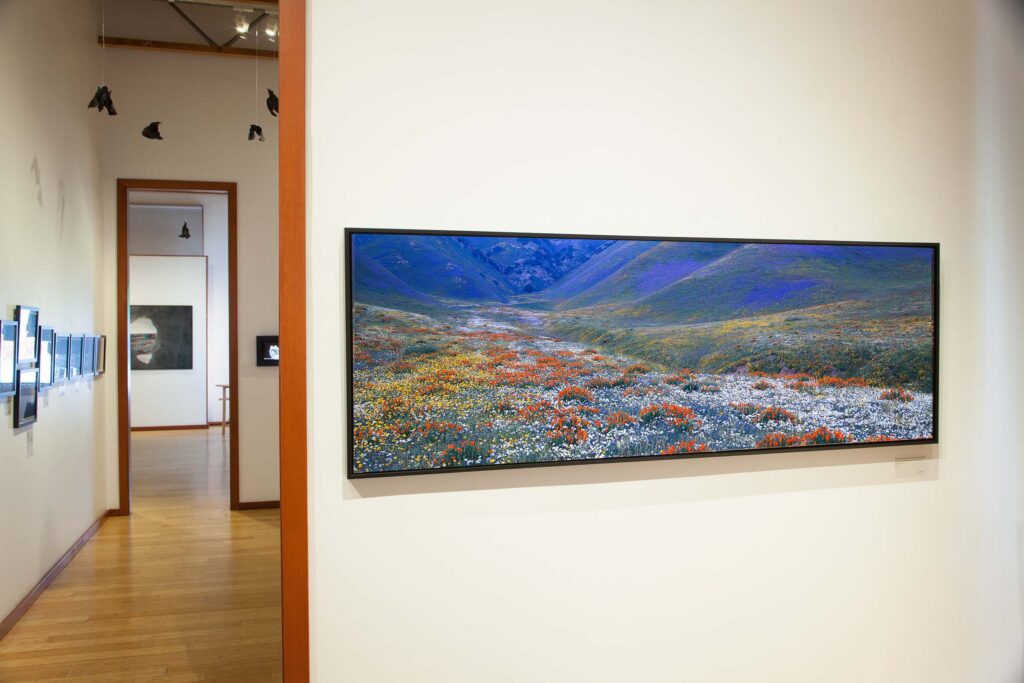
In 1991, the Fuji GX617 panoramic camera became part of the project. Its large 6×17 cm transparency film frame produces a true 3:1 panoramic photograph, allowing broad valleys, hillsides and mountain foothills to be recorded within a single sweeping frame. Digital photography later extended the archive while continuing the traditional 3:2 proportions of 35mm photography.
Across those different cameras and formats, the photographic process remained rooted in recording what was physically present before the lens. For much of the archive, that record still exists in its original analog form.
The Analog Record & Archival Process
Much of the Feral Flowers archive survives as original film transparencies dating back to the 1980s. While photographs made with digital cameras are also represented within the later archive, the great majority of the photographic record was created on film and the analog originals remain its foundation.
When viewed directly on a light table through a magnifying loupe, these transparencies reveal the color, fine detail and depth physically contained within the film.
They are more than source material for reproduction. Each transparency is a physical photographic record made when light reflected from an actual landscape passed through the camera lens and exposed the film at a particular place and moment in time.
That physical connection has taken on new significance in an increasingly digital world. The renewed interest in film cameras, vinyl records, cassette tapes and other analog media reflects, in part, a desire for objects with a tangible connection to their origins. The original Feral Flowers transparencies provide that connection and establish a form of photographic provenance extending back four decades.
Digital photography later became another means of continuing the record, but it did not replace its analog origins. Film remains the predominant medium represented throughout the archive and provides a physical record of many landscapes as they appeared decades ago.
As artificial intelligence, CGI and digital fabrication make it increasingly possible to create convincing landscapes that never existed, the analog archive carries an additional significance. These photographs were not imagined or generated. What appears on the original film was present before the lens — light, landscape and wildflowers recorded directly onto a physical photographic medium.
Original 35mm and Fuji GX617 transparencies preserve the photograph as it was captured on film. Polarizing filters were sometimes used in the field to reduce atmospheric haze and surface glare, allowing greater clarity and color separation under intense sunlight.
Film originals are digitized using professional equipment including Nikon 4000 Coolscan, Flextight 949 and drum scanning when required, preserving the color depth, tonal range and fine detail contained in the original transparency.
Printing at Architectural Scale
The printing process began in the traditional darkroom, with hand burning and dodging of black-and-white prints and work with Cibachrome. Modern digital workflows now allow the original film archive to be reproduced with exceptional control while preserving the character of the source transparency.
High-resolution scans intended for large-scale printing are carefully prepared to preserve edge acuity, tonal richness and the structural detail of the original film. Because of the expansive area of the 6×17 cm frame, Fuji GX617 photographs can retain remarkable clarity at mural scale.
Prints exceeding ten feet in width have been produced from the panoramic archive, including a permanent wildflower mural installation at the Frazier Park Library.

Publications & Exhibitions
Selected Publications
Saving the Super Bloom · April 2021
Journal of the California Native Plant Society · Richard Dickey · Winter 2009
Richard Minnich · University of California Press · Book Cover · May 2008
Center for Biological Diversity, Sierra Club and Natural Resources Defense Council · Brochure · May 2007
Magazine · Fall 2006
Magazine · April 2006
January 2006
August 2005
Selected Exhibitions
Theodore Payne Foundation fundraiser · Exhibit View 1 · Exhibit View 2 · Exhibit View 3
Permanent exhibit · Panoramic Wildflower Murals
Beacon, New York · Group exhibit · Jurists Leonard Freed and Helen Wright
Osaka, Japan
Institutions & Clients
Award
Gorman Wildflower Preserve UCLA · American Society of Landscape Architects · September 2006 · View Award
All photographs presented on Feral Flowers are original photographic works created by Richard Dickey. Much of the archive survives on original film transparencies dating back to the 1980s. No photographs displayed on this website are AI-generated, CGI-created or digitally fabricated as landscapes.
All photographs presented on this website are part of four decades of original photographic work and are registered and copyrighted with the U.S. Library of Congress. Unauthorized use, reproduction, distribution or copying of any image is prohibited without prior written permission. All rights reserved.