Layers of Gorman
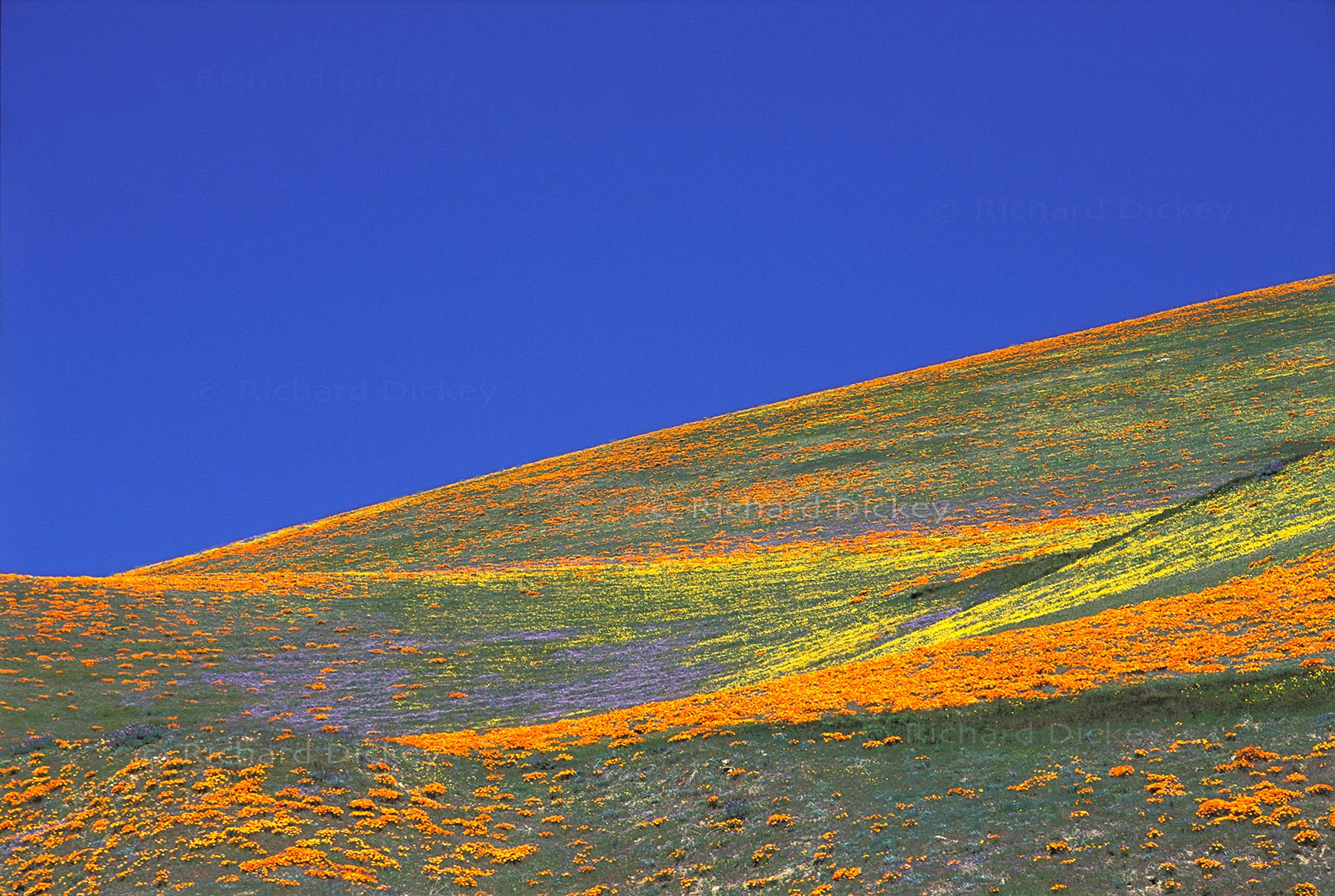
The Gorman Hills preserve ancient alluvial sediments deposited over millions of years and later uplifted as the San Andreas Fault system shaped this part of Southern California. Across this steep slope, the sedimentary strata can still be traced as long horizontal bands. During the 2001 bloom, wildflowers followed these contours in remarkably distinct ribbons of orange, yellow, lavender and green, giving the landscape a striking striated appearance. The layers of spring color seemed to echo the much older geological layers beneath them, making the underlying structure of the land visible through the bloom.
California poppies are notoriously sensitive to conditions. Their flowers open during periods of warm sunlight and may remain closed when temperatures are cool, winds increase or clouds block the sun. On this clear day, several hours of high sun opened the poppies across the steep Gorman hillside.
A polarizing filter deepened the clear bluebird sky to an intense indigo, creating a strong contrast with the orange and yellow bands below. California poppies, golden linanthus, lacy phacelia and Adonis lupine followed the folds and old sedimentary layers across the hills.