Tierra del Fuego
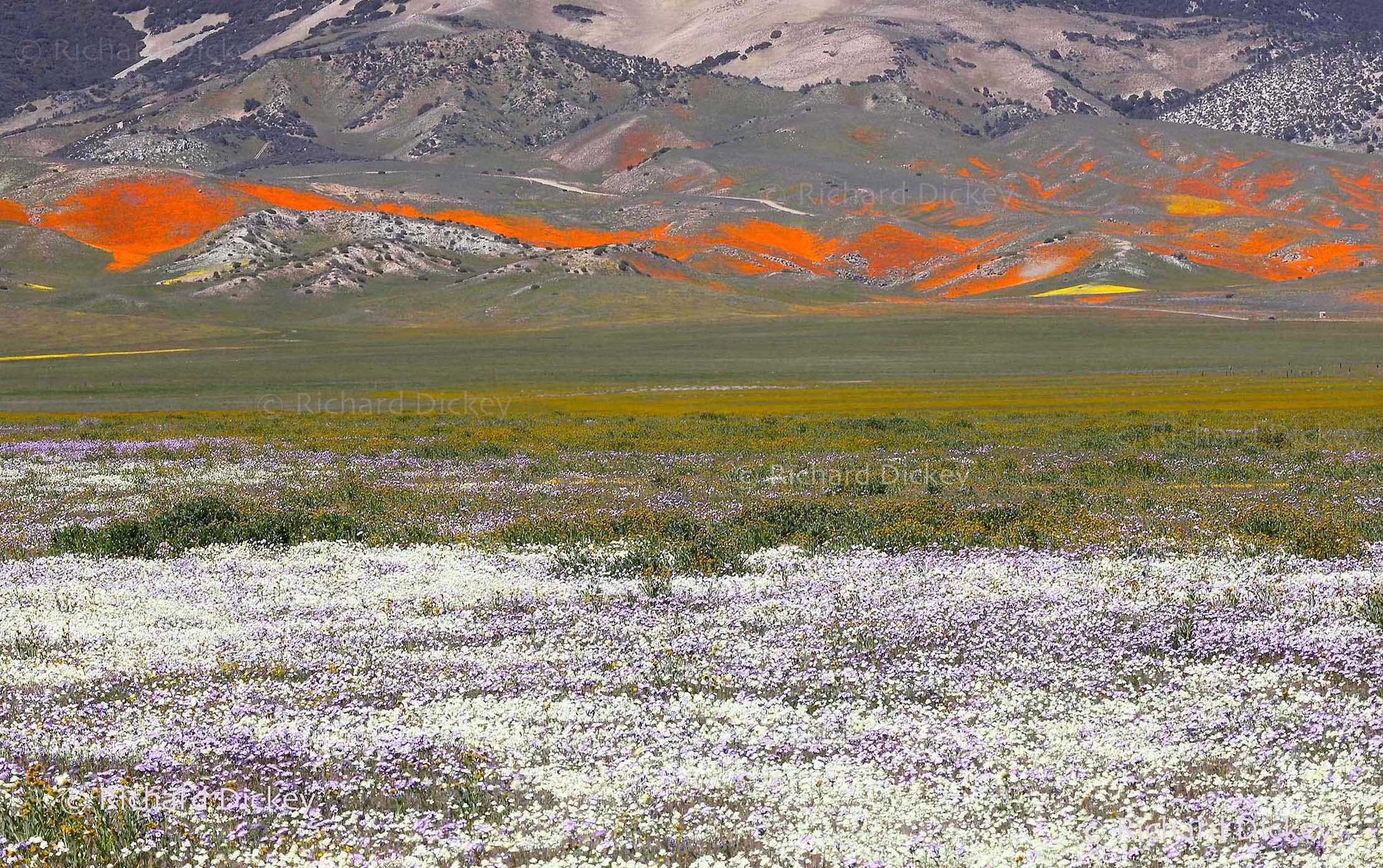
Photographed from outside Tejon Ranch, this view looks across the valley toward foothills covered in intense bands of California poppies. Even from miles away, the orange remains strikingly bright, revealing the extraordinary density and scale of the 2019 super bloom.
In the foreground, creamcups, Davy gilia (Gilia latiflora), fiddlenecks (Amsinckia intermedia), goldfields (Lasthenia californica) and Monolopia (Monolopia lanceolata) create another layer of color before the eye reaches the distant poppy-covered slopes.
California poppies can be remarkably reflective in full sunlight, appearing almost luminous when massed across a landscape. Pollinating insects perceive flowers differently from humans, including ultraviolet wavelengths invisible to our eyes. These floral signals can increase contrast against surrounding vegetation and may help pollinators locate flowering plants from a distance.
The first impression was how intensely the distant hills appeared to glow. The photograph was made from outside Tejon Ranch, yet the poppy-covered slopes were unmistakable from miles away—broad orange bands cutting across the foothills like fire.
That brilliance becomes even more striking when standing near a dense field of fully open California poppies. In strong sunlight their reflective petals can create an extraordinary amount of visible glare, making sunglasses useful when looking across the flowers for extended periods.
What is particularly fascinating is that a pollinating insect experiences this same landscape differently. Bees and other pollinators can perceive ultraviolet wavelengths invisible to human vision, adding another layer of floral contrast and signaling to flowers already extraordinarily conspicuous to us. At the scale of a super bloom, millions of flowers together create a visual presence far greater than any individual plant.
The foreground bloom of creamcups, Davy gilia, fiddlenecks, goldfields and Monolopia adds an important counterpoint to the distant orange hills. This was not simply a hillside of poppies but a much broader wildflower event extending through multiple layers of the landscape.