Adonis Lupine on the Hillcrest
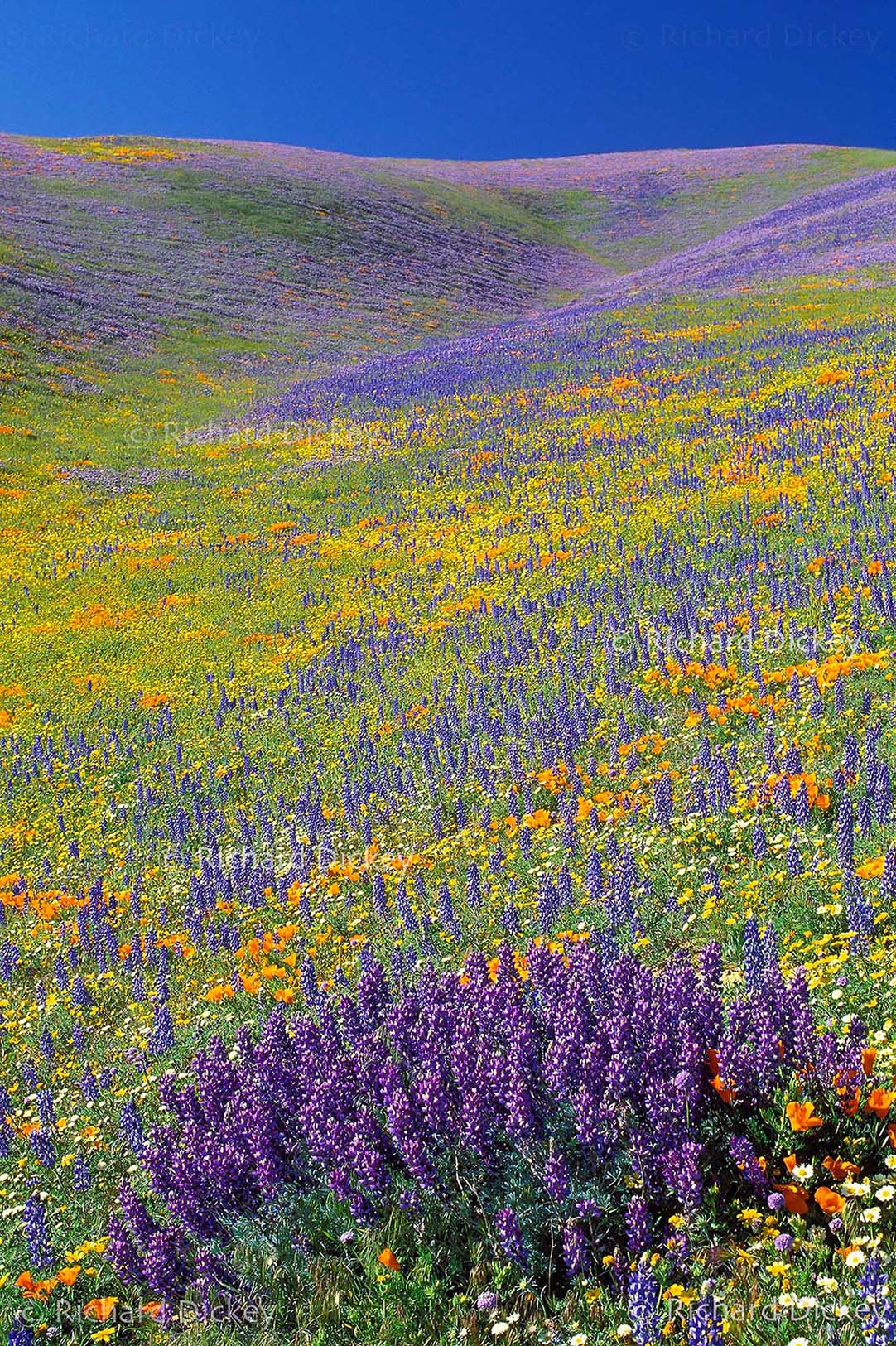
This photograph records an astonishing concentration of wildflower species within a single Gorman vista. Lacy phacelia dominates the upper hillcrest, forming a broad blue-violet sweep across the skyline. Below it, the hillside becomes a dense mosaic of Bentham lupines, California poppies, coreopsis, globe gilia, Fremont pincushion, goldfields, white layia and fiddleneck. An Adonis lupine has an almost magical presence, its deeper purple flowers standing apart from the immense mixture extending across the slopes beyond, like a sentry towering over the wildflower-covered hillside.
Coming across this scene produced one of those rare moments of complete astonishment—whether from the altitude, the thin air or simply the extraordinary variety spread across the hillside. The abundance was remarkable not only for its density but for the number of different wildflowers growing together within one vista.
Ideal light revealed layers of color extending from the Adonis lupine in the foreground through broad mixtures of Bentham lupines, California poppies, coreopsis and smaller wildflowers before reaching the lacy phacelia along the upper crest. Fine lines etched across the distant hills also reveal ancient sedimentary layers, a reminder that this brilliant seasonal display was growing across a landscape shaped over millions of years.
Adonis Lupine — Lupinus excubitus
A photograph can record the extraordinary color and scale of Adonis lupine but it cannot preserve one of the plant’s most memorable characteristics: its fragrance. Lupinus excubitus is also known as grape soda lupine and the name is remarkably appropriate. As warm desert sunlight reaches the flowers, their sweet fragrance can resemble grape soda or grape bubblegum. When a light breeze moves across a stand of these plants, the scent can lift from the flowers and drift across the open landscape.
The botanical name carries its own unusual mystique. The Latin lupinus means “of a wolf” or “wolf-like,” derived from lupus, the Latin word for wolf. The specific name excubitus comes from a Latin form associated with having “kept watch” or “slept outdoors.” Marcus E. Jones formally described Lupinus excubitus in 1898 but did not explain his choice of the name in the original description. For that reason, “the wolf keeping watch” should not be considered a literal translation intended by Jones. Still, it is a difficult poetic image to resist for a perennial desert lupine holding its place on exposed mesas, washes and slopes year after year.
The common name Adonis adds yet another layer. An older guide to desert wildflowers described the name as a reference to the plant’s exceptional beauty. Together the names evoke beauty, a wolf and a watch kept beneath the open sky while “grape soda lupine” recalls something entirely different and immediately recognizable—the fragrance of the flowers themselves.
Perhaps that combination is also why Lupinus excubitus has long been one of the photographer’s favorite botanical names simply to sound out and say aloud. Even without knowing the Latin, its rhythm seems less like an ordinary plant name and more like an incantation from a Harry Potter film. Knowing that somewhere within the words are a wolf and a watch kept outdoors makes the name seem a little more magical.